
Chuo Freeway by Yumi Arai: The Song She Wrote and the Man She Married

Chuo Freeway is a song Yumi Arai released in 1976. She wrote both the words and the music, and the arrangement is by Masataka Matsutoya. The two married soon after, so the credits hold a couple who were about to become husband and wife, listed as writer and arranger.
What the song describes is a drive on a real highway heading west out of Tokyo. And among the players in the credits, alongside Japan's top session musicians, are a few names you would not expect. I'll go through them one by one.
Yumi Arai's Last Album
Chuo Freeway is the fifth track on side A of The 14th Moon (Juyonbanme no Tsuki), Yumi Arai's fourth album, released by Toshiba EMI on November 20, 1976. It was the first of her albums to reach number one on the Oricon chart, and the last record she made under the name Yumi Arai. It was also the first album that Masataka Matsutoya, who had arranged her earlier work, produced.
Words and music by Yumi. Arrangement and keyboards by Masataka. The floating, weightless electric piano of the intro sets the temperature of the whole song.
The Lyrics: A Real Road, and the Memories It Brings Back
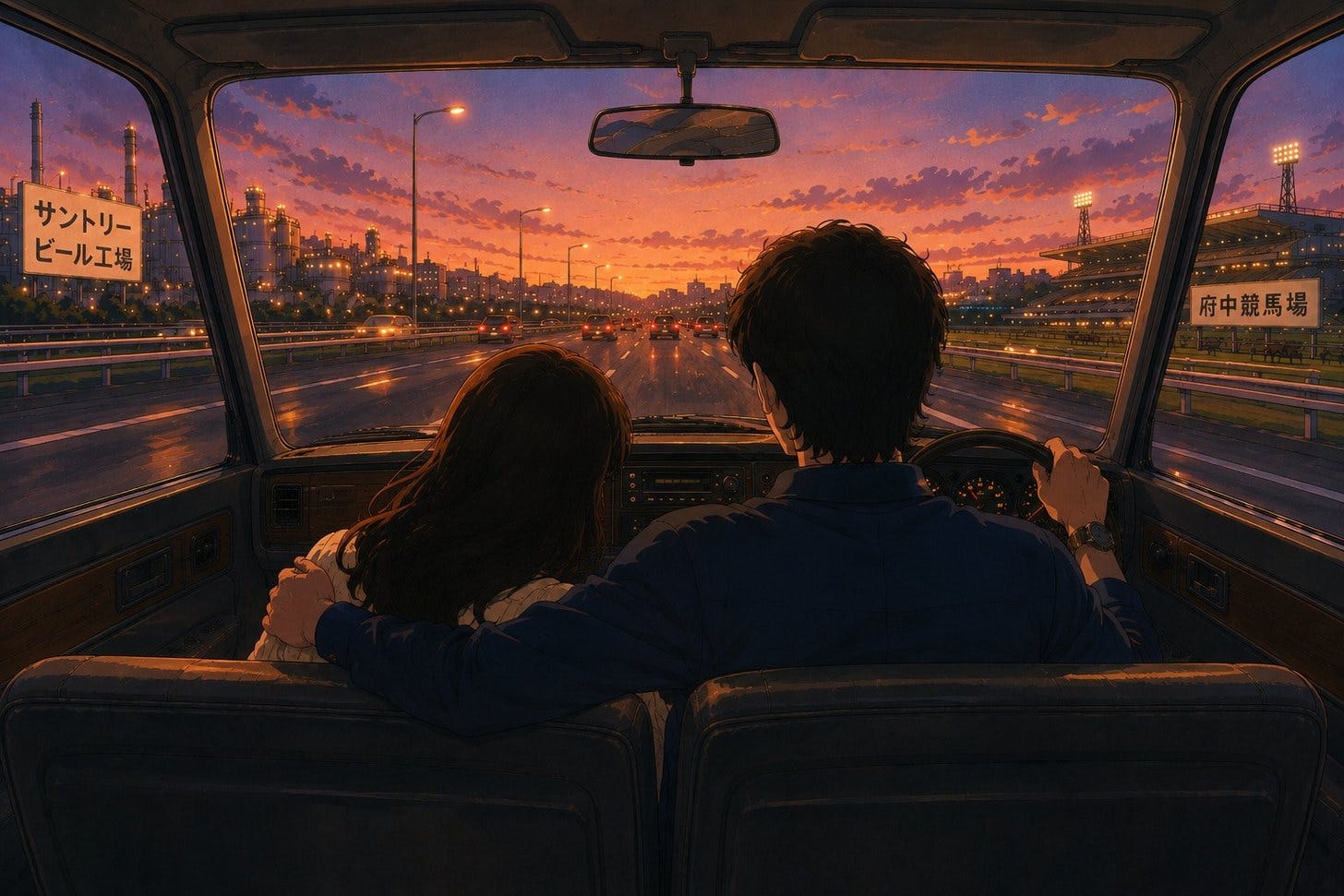
The first thing to know is that Chuo Freeway is the name of a real road. The Chuo Expressway runs west from Takaido in Tokyo, through Hachioji, toward the mountains of Yamanashi. A road that leaves the city behind and heads for the hills. The song takes its title straight off the highway sign. In English it is the Chuo Expressway, and Yumi called it a freeway.
What Yumi pulled off in this lyric was to set the most concrete, least romantic proper nouns right in the middle of a love song. A racecourse. A beer factory. A former American military base. A love song usually keeps its setting vague, so that it can dissolve into anyone's memory. Yumi did the opposite. She named specific places and buildings, and put them into the song by name.
And strangely, that concreteness does not turn the song into a travel guide. It works the other way. The proper nouns cut in two directions. For someone who has never driven this road, they build a scene out of nothing. For someone who actually has driven it, they bring back, in an instant, the dusk on the Chuo Expressway as they drove it themselves. The moment you hear racecourse, beer factory, your own private Chuo Freeway starts to play. Yumi did not so much describe a landscape as plant a switch in the lyric that draws each listener's own memory out of them.
And every one of those places is real. You pass the Chofu Base, a US military airfield returned to Japan in 1974, and on the outbound side heading toward Hachioji, the Tokyo Racecourse appears on your right and the Suntory beer factory on your left. They line up in that order on the actual Chuo Expressway. Because the outbound lanes run west, if you drive it in the evening, the sinking sun pours straight onto your windshield. The dusk the song paints is not a poetic decoration. It is the exact view that anyone who has driven this road at evening already carries. That is what makes the switch flip so reliably.
If you are reading this from outside Japan, you are on the other side of that line. Hand you the proper nouns and no memory rises, because you have never made the drive. But once you know these are real places, and that for a Japanese listener they work as a trigger, the song starts to sound different.
The road itself had only just reached the center of the city the same year the song appeared, in 1976. The stretch linking Takaido to central Tokyo had been stalled for years, and it was finally joined to the metropolitan expressway that spring. Driving the Chuo Freeway was, at the time, still a new experience.
Reading the Credits
Open the credits, and the real shape of the song comes into view.
Masataka Matsutoya (arrangement, keyboards)
The arrangement, and the keyboards, are by Masataka Matsutoya. This was the first of Yumi's albums he produced, and he would go on to shape nearly all of her work after it. Masataka was one of the members of Caramel Mama, later Tin Pan Alley, alongside Haruomi Hosono, Shigeru Suzuki, and Tatsuo Hayashi. He was the keyboard player in that group, the one that laid the foundation for Japanese pop in the 1970s, and he became one of the era's defining arrangers and producers, with countless records to his name. Shigeru Suzuki, listed on guitar here, came from the same circle.
And The 14th Moon was the last record Yumi made before marrying. Soon after, the two wed, and Yumi Arai became Yumi Matsutoya. That floating electric piano intro is Masataka's signature on the record, and a record, too, of the moment two lives crossed.
Guitars: Masaki Matsubara and Shigeru Suzuki
The album credits two electric guitarists side by side: Masaki Matsubara and Shigeru Suzuki. The credits do not spell out who played what on each track, so I will not assign parts here. I will only note that the two names stand together.
Masaki Matsubara would become one of Japan's most recorded session guitarists, with a tone you can pick out in a second and, by some counts, well over ten thousand recordings behind him. He died in 2016, at 61. In 1976, though, he was only 22, standing at the very start of a long career. His is a name that will keep coming up here.
Shigeru Suzuki, the other, is a guitarist out of the world of Happy End and Tin Pan Alley.
Rhythm section: Leland Sklar and Mike Baird
This is where the song surprises you. The bass and drums under this very Tokyo drive belong to two session players from Los Angeles.
On bass is Leland Sklar, a member of The Section, the band behind James Taylor, Jackson Browne, Carole King, and Linda Ronstadt, the group that built the sound of soft rock through the 1970s and 80s. Sklar has played on well over two thousand albums and later toured with Phil Collins and Toto. On drums, Mike Baird was another West Coast session regular.
American session players turning up on Japanese records is not unique to this song. Plastic Love had Ernie Watts. Hoho ni Yoru no Hi had David Sanborn.
About the chorus, I want to be straight. The album's overall credits list the backing vocalists together: Tatsuro Yamashita, Minako Yoshida, Taeko Onuki, Amii Ozaki, Time Five, and Corporation Three. But there is no track-by-track breakdown of which voice sang on which song, and the chorus line for Chuo Freeway itself is left blank. So I cannot name who sang on it. What the credits tell us, and what they hold back, are both here.
Afterward
Chuo Freeway kept being sung after that.
Hi-Fi Set was a vocal group that debuted in 1975 with Sotsugyo Shashin (Graduation Photo), a song Yumi wrote. In 1977 they covered Chuo Freeway on their own album Love Collection, and their polished harmony was loved so widely that many people picture their voices when they think of the song. At the center of that harmony is the lead vocalist, Junko Yamamoto. If you know the clear, soaring voice on Akai Tori's Tsubasa Wo Kudasai (Give Me Wings), that is her.
But their names are not in the original record's credits. They were the ones who inherited the song.
Open the credits of that cover, and there is a small discovery. The guitar is again Masaki Matsubara, the same as on the original. Across both versions, the same session guitarist had a hand in this song. And the drums are Shuichi "Ponta" Murakami, another of the giants of Japanese session drumming.
In closing
Open the credits of Chuo Freeway and a number of things come into view. Two people about to marry, Yumi and Masataka. A road that had only just reached the city. A young guitarist standing at the entrance of a long life in the studio. And two players from Los Angeles anchoring a Tokyo night drive.
Masaki Matsubara, Shigeru Suzuki, Leland Sklar: none of them is a name for this one song alone. They will turn up again in the credits of other songs I cover here.